
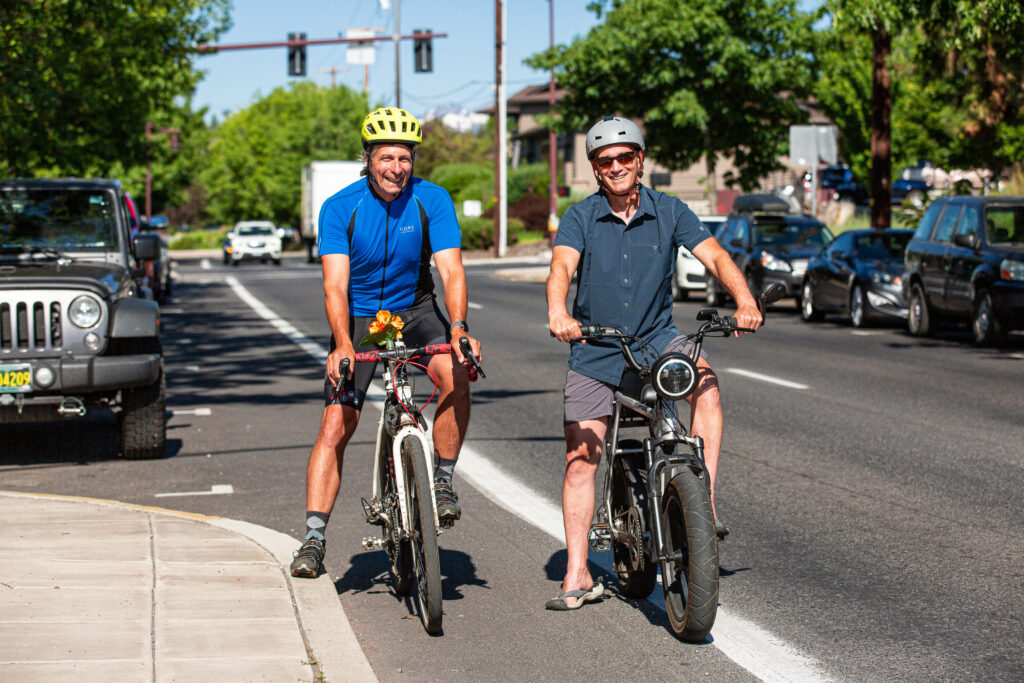
You learned to ride a bike years ago. You can balance, brake, signal a turn, and check over your shoulder without thinking about it. So when someone suggests e-bike safety training, it is fair to wonder what could possibly be new.
The honest answer is that an e-bike is not just a bike with a battery. It is heavier, faster, and treated differently under Oregon law. The habits that kept you safe on a regular bike still matter, but they are no longer enough on their own. Here is why training is worth an hour of your time, even if you have been riding your whole life.
An e-bike behaves differently than the bike you grew up on
The first time most people ride an e-bike, they’re surprised by how quickly it gets going. Pedal assist means you reach traffic speed in a few pedal strokes instead of a block or two. That changes everything about how you approach an intersection, merge into a bike lane, or pass a pedestrian on a multi-use path.
The extra weight matters too. E-bikes carry a motor and a battery, which means they take longer to slow down and handle differently in a tight turn or on loose gravel. Braking distance that felt automatic on your old bike may leave you short on an e-bike.
None of this makes e-bikes unsafe. It means the instincts you built on a lighter, slower bike need an update. That is what e-bike safety training does. It closes the gap between what you already know and what your new bike actually does.
Oregon has specific rules for e-bikes, and most riders have not read them
E-bikes fall into different classifications based on how the motor works and how the bike assists you. Those classifications affect where you can ride and what rules apply. A rider who has never looked into this may be on a path where their bike is not allowed or may assume rules that apply to one type of e-bike apply to all of them.
This is one where experience on a regular bike doesn’t help. Traditional bicycles do not have classifications. E-bikes do, and the differences are not obvious from looking at the bike.
Our free online e-bike safety course covers the classification system and the Oregon road rules that go with it. We also host a recorded webinar on Oregon e-bike law with Chris Thomas, which walks through the gray areas riders ask about most. Both are linked on our E-Bike Safety Course page.
Drivers, pedestrians, and other cyclists are not expecting your speed
A driver at a stop sign glances left, sees a cyclist half a block away, and pulls out. On a regular bike, that math usually works. On an e-bike with pedal assist, you cover that half block much faster than the driver expected. They misjudged your speed because they were expecting a bicycle, not something moving closer to the pace of traffic.
The same thing happens on shared paths. Pedestrians and slower riders judge how much room they have based on a bicycle’s normal pace. When you approach faster than they expect, you become the surprise.
Crash prevention is a core part of our e-bike safety course for exactly this reason. We cover hazard awareness, how to anticipate what other road users will do, and riding techniques that account for the way an e-bike changes your position on the road.
Battery care is a new skill, and it is a safety issue
Nobody needed to think about charging a bike before. Now you do. How you charge, store, and maintain an e-bike battery affects both how long it lasts and whether it becomes a hazard in your home or garage.
This is not something you can pick up from years of riding a regular bike, because there was nothing to learn. Our course includes a module on battery safety and maintenance so riders know the basics before a problem shows up.
Who e-bike training is for
Our course is built for riders at every level. That includes:
- People who have never been on an e-bike and want to know what to expect
- Long-time cyclists switching to an e-bike for commuting or errands
- Riders who have had an e-bike for a while and want a refresher on the rules
- Parents helping a teenager who is 16 or older understand where and how they can ride legally in Oregon
- Anyone who wants to feel confident in traffic before their first real ride
Experienced cyclists sometimes assume training is only for beginners. In practice, they often get the most out of it because they have the most habits to adjust.
What our online e-bike safety course covers
The course is free, online, and self-paced. You can take it in English or Spanish, and we also offer a printable version with a quiz for anyone who prefers paper. By the end, you will have covered:
- E-Bike Basics and Classification: what an e-bike is, how the classification system works, and what types are on the road
- E-Bike Road Rules and Infrastructure: how to ride legally, how to use bike lanes and multi-use paths, and which areas to avoid
- Crash Prevention and Safe Riding Techniques: hazard awareness and riding skills that account for e-bike speed and weight
- Battery Safety and Maintenance: charging, storage, and care practices that keep your bike and your home safe
- A refresher section for riders who want to reinforce what they already know
If you want more background before you enroll, we have an e-bike information packet and a recorded Walk + Roll e-bike panel discussion available on the same page.
Why we offer this for free
Commute Options has worked since 1991 to give Oregonians safe, convenient, and reliable ways to get around. E-bikes are one of the most practical options to come along in years. They make longer commutes realistic, flatten out hills, and get people out of cars for trips they would not have made on a regular bike.
We want that to keep growing, and it will only keep growing if riders stay safe. Training is the simplest way to make sure a new e-bike becomes a long-term habit rather than a short-lived experiment.
If you are ready to ride, you can enroll in the free e-bike safety course now. If you have questions about the course or any of our other programs like Get There Rewards or Oregon Friendly Driver, call us at +1 541-668-6138 or send us a message. We are happy to help you get started.